The frequent showing of black streaks in our otherwise white quartz and feldspar sands demanded a background check on our beaches in general.
The backstory to Island sands is dominated by Pennsylvania’s Appalachian Mountains, early form.
It’s hard to envision, but those now gently rolling hills were once mountains as towering and majestic as the current Himalayas. The range sported snowcapped peaks over 20,000 feet in elevation. Of course, that was hundreds of millions of years ago, during Pangaea times.
So, where are those peaks now? Literally beneath our feet, at least in small part.
It wasn’t long after the Appalachians arose from tectonic plates being driven upward during continental land mass collisions that the intractable erosional power of the weather moved in, attacking the spiraling peaks with wind, rain, ice and snow.
Earthquakes also contributed to the Appalachian erosion, despite having had a huge part in first building the range.
Over a span of roughly 10 million to 12 million years, powerful ancestral river systems began cutting through the mountains.
Broken-down mountain materials collapsed into the rushing waterways, wherein larger pieces were broken apart by the tumbling action, becoming gravel and eventually fine tumble-polished grains.
The erosional mountain material traveled downward and oceanward. Ultimately, the mountain sediment accumulated at the mouth of an ancient river, vaguely located where the Delaware River now flows. It formed the Cohansey Delta, now known as South Jersey.
According to Wikipedia, “A massive ancestral river system flowing from the Appalachian Highlands … carried vast amounts of sand and gravel, depositing it into a shallow sea covering southern New Jersey.”
The shape of southern N.J. does indeed have a delta look to it.
All that succinctly explained, I can finally dwell on those beachy black sand streaks on LBI.
No surprise by this point, they stem from dark mineral pass-alongs from the Appalachian range.
As to their exact mineral content, research shows they’re mainly made up of magnetite and ilmenite, both magnetic.
More exotically, black sand can also include garnet, epidote, rutile, zirconia and glauconite, along with specks of highly rare minerals washed down from the mineral-rich north part of the state.
As to how the black streaks seem to suddenly surface along the beachline, it comes about when wave and wind action whisk away lighter quartz grains, leaving the heavier material behind. This process is known as natural placer concentration, or wave winnowing.
Studies are being done to determine if additional black sand is being pumped in during beach replenishment. It’s highly likely, because the suction-dredged material from offshore borrow areas contains a more varied geological makeup than beach sand, especially when the material is dredged from deeper down.
THIS AND THAT: (This is a new column concept. It’s hungry for local input about sundry things. Feel free to drop a line at jmann99@hotmail.com.)
I see reports of a Bigfoot sighting near New Gretna. Interesting. Just last week, I mentioned being contacted about just such a sighting (somewhat) in that general area. As the Bigfoot flies, that’s not all that far. See facebook.com/groups/62529530168/.
Fascinating Beach Haven West tidbit – something I might have already known. That community’s maze of lagoons, now sporting homes worth millions of dollars apiece, is still strictly owned by the Shapiros, the family that built the community from scratch.
That ownership recently came to the fore when dredging was being proposed to deepen the waterways. The Shapiros had to first give the final OK, which was done.
I’m not sure what to make of a couple of the whale sightings. Not the whales themselves, but the immense school of nearby bunker, easily seen in drone photos. Considering our water had been wanting of these baitfish, I wonder if the whales themselves drove the bunker this way. Not impossible.
On the menhaden front, this week (Nov. 10) we’ll see how the Atlantic States Marine Fisheries Commission intends to respond to rallying calls for and against increased protection of the most essential forage fish in the sea.
According to seafoodsource.com, “The issue has garnered 48,000 public comments from individuals, organizations, and form letters; seven different public hearings; and pro- and anti-fishing campaigns from organizations up and down the U.S. East Coast.”
A few showy adult eagles are out and about hereabouts. One female I saw was particularly large even by eagle standards.
By the by, the phenomenon of females being genetically larger than males is called reversed sexual size dimorphism, common among birds of prey, such as eagles, hawks, owls … and striped bass.
Beach buggying has become bothersomely boggy, especially mid-Island. The gathering tracks from buggies have torn up the sand. Making matters worse, long-term drying conditions have left the sands sinky to hell and back. If readying for a beach run, air down to the max. Worst sinks are entrance and exit points.
On the no-snow front, the Jersey Shore is within a huge swath across the upper U.S. that forecasters say will see 25% less snow.
It’s not like we were rolling in the white stuff to begin with. LBI averages 10.2 inches per winter.
I was asked by Dave W. of Tuckerton about any “updates on Horseshoe Island,” post nor’easter. He wrote, “It still has the same amount of acreage but got really flattened out and lost all of its beautiful high dunes and growth except for one little tuft that is left.” The new island is a wonderful sand buildup. The birds love it. Here’s hoping it’s not a case of easy come, easy go.
I got an email about a very attractive bright green Italian wall lizard spotted and photographed in a dune area of Harvey Cedars. Ciao. “We were entering the dunes in Harvey Cedars when we spotted this guy basking,” said the spotter. He also mentioned that a colony of this invasive species has apparently been established on LBI. I’d like one for a pet.
THE TOAST OF HOLDAY FEASTS: It might seem a little early to hype holiday meals. Not so when said feasts can include a stunning whole baked striped bass entrée.
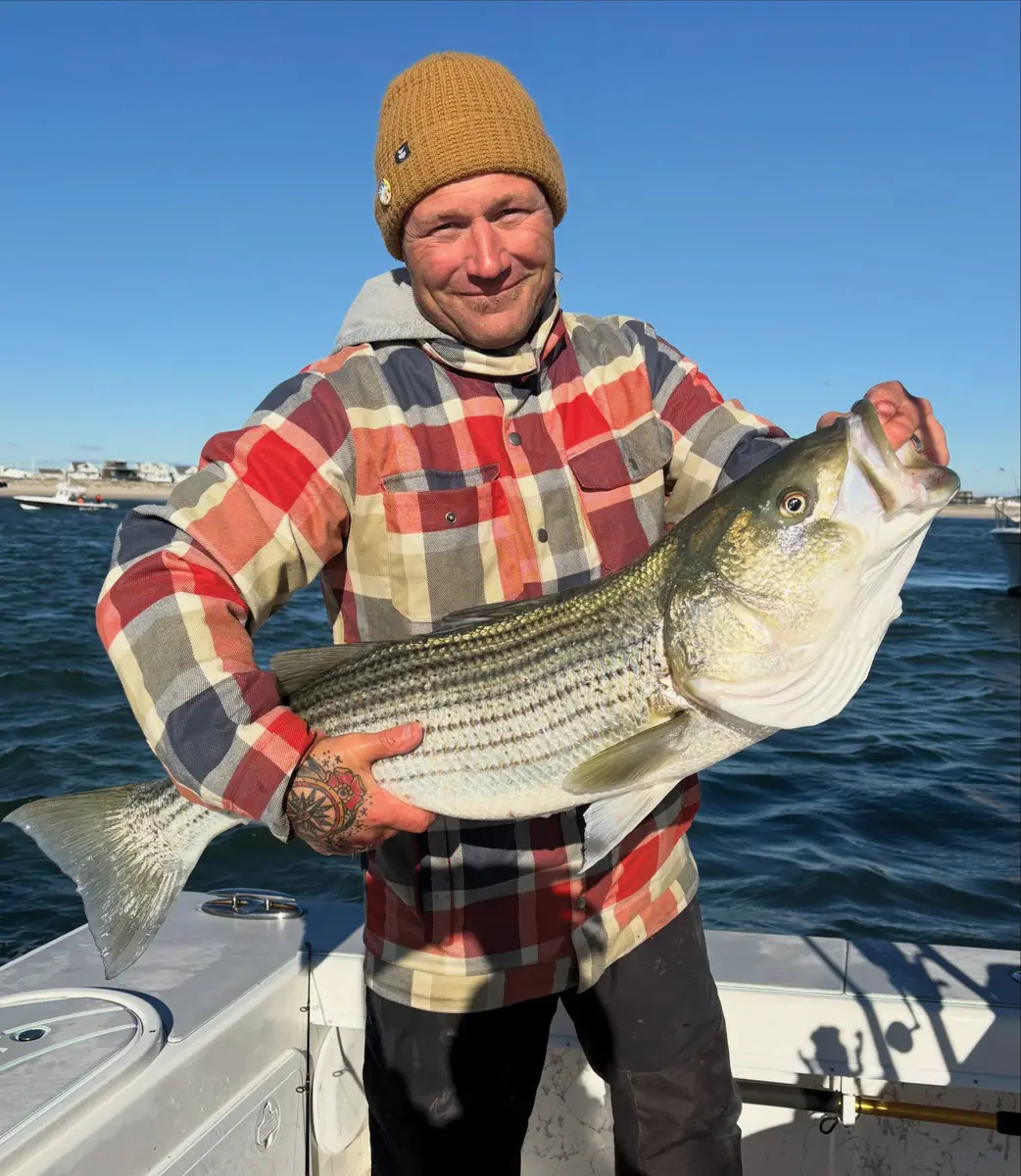
We’re still within peak angling time to score a legal-sized 28- to 31.99-inch bass, which happens to be an excellent size to freeze in the round. The closer we get to the holidays, the tougher it becomes to catch a take-home striper.
When putting up a striper for upcoming events, always think in terms of freezing an entire fish, head and all. This retains its maximal flavor and allows the greatest meat gain. It also makes a stunning table presentation.
It’s worth noting that frozen bass filets lose far too much pizzazz, though a good marinade can add some spunk.
Modest prep work is needed to properly clean and freeze a whole bass.
The following procedure focuses on a 10-pound bass, the average size of legal bass once eviscerated, a fancy term for gutted.
Things begin with the gutting and gill cleaning, though not necessarily beheading.
As to the scales, just leave them right where they lay. They’ll cleanly come off with the skin, post baking.
Once gutted, the body cavity must be rinsed in cold water. Use maximal spigot flow or a faucet sprayer. A vegetable scrubber can also be used to fully clean out the cavity.
Pat the fish dry inside and out, using plenty of paper towels.
Now to the somewhat involved pre-freezing wrapping process.
On a table or counter, place two partially overlapping parallel lengths of plastic wrap (3 feet in length), forming a single “double-wide” sheet. This width is needed to cover the fish’s length.
Position the fish vertically at one end of the wrap and roll toward the other edge, pulling the wrap tightly, applying added pressure at the head and tail.
Once the fish is tightly encased, use some narrow pieces of wrap or aluminum foil to enforce the pokey points caused by sharp dorsal, pectoral and anal fins.
For perfectionists, repeat the above plastic wrap process, double layering the fish.
As a final freshness containment effort, wrap the whole striper shebang with a layer of aluminum foil or butcher paper.
Things are now ready to get icy.
Center the bass in the back of the freezer, loosely surrounding it with a few already frozen items that won’t be needed until the holidays. This creates a heat sink, which absorbs temperature spikes, preventing freezer burn.
Onward to the big occasions – and the make-or-break step of thawing. It’s as important as all the readying done to this point.
As is the case with most frozen seafood, a slow thaw is imperative. It’s best done by placing the wrapped thawee in the back of the fridge for a cozy stay. Therein, it takes 24 to 36 hours to fully (and properly) thaw out. Never thaw at room temperature, and don’t even think about running spigot water over it.
Once thawed, pull the coddled fish from the fridge, take off the foil and set it on some newspapers (SandPapers?) and unwrap. A box cutter or sharp knife can be carefully used to hasten the process by cutting through all the layers.
Time the unwrapping. Do not allow the fish to sit out prior to cooking.
According to experts, bake a striped bass at 350°F to 375°F rather than a higher heat.
“A very large fish needs a moderate temperature, so the outside does not dry out or burn before the thickest part cooks through,” offers one chef.
Since you might already have an internal thermometer around for the turkey, give the bass a poke inside the body cavity. Ideally, it should be 135°F to 140°F.
Do not co-bake turkey and bass in the same oven, especially if you have strict pescatarians coming to dinner. Turkey vapors are very invasive.
For the coup de grâce, place the steaming fish on a suitably sized platter and present at the table – to “oohs” and “ahhs.”
Then, with carver fanfare, carefully (steam alert) peel off the skin and scales. Every morsel can easily be forked off.
Enhancement: Serve with melted no-salt butter, lobster style.
RUNDOWN: Striped bass are on the menu (see above) with a semi-decent showing of stripers along the beach. Not that we’re up to snuff just yet, but this entire fall, fisheries have been running a bit late, so here’s to the bass making a late run, most likely comprised of schoolies and take-home sized fatties.
While I pretty much leave boat fishing to shop websites, I see-tell that tons of cows are being caught just off our beaches, with a slight tilt to just north of LBI.
Not to whine, but for years now the bass biomass has been reluctant to move onto the beachline of LBI. I fear it’s a lack of forage, mainly surf clams. Back when I kept stripers for dining pleasure, clams ruled bass bellies. The loss of groins also removed prime feeding attractions.
Tog fishing rages on, possibly due in small part to this column. The 2026 LBI Surf Fishing Classic has seen 46 blackfish weigh-ins, leading all other event species. Having made many visits to the B.L. South Jetty this fall, I got a good read on the hooking – and the steady Division of Fish and Wildlife presence. Those officers have kept jetty fishing on the up-and-up.
Speaking of that jetty area, I need to give a shout-out to Andy’s Coffee Shack, which is remaining open all winter, serving anglers with a gorgeous place to warm up while keeping an eye on the inlet water. Per the Shack’s Facebook page, “Happy winter hours! Still open every day – just closing at 4 pm every day but Saturdays.”
NOTICE: The online version of The SandPaper (thesandpaper.net) has taken on a new look. Take some time to explore the new look, then tune in for various upgrades, including added photos per online article.
To quickly reach “The Fish Story,” click on “News” at the top of the opening page. Once in “News,” check the listing of options in blue near the top of the page. Mine is among those, though it might take time to include recent stories.