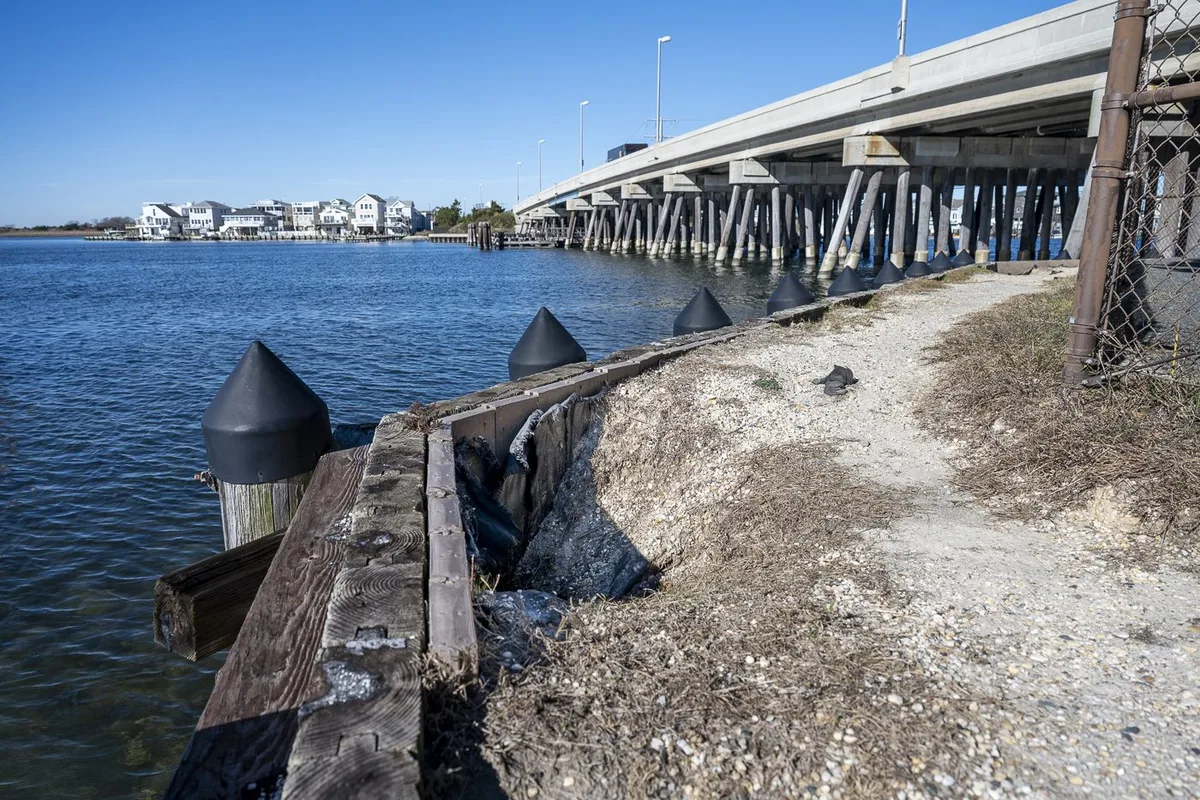
On a cold, damp November Friday morning, the walkway under the bridge connecting Ship Bottom’s north and south sides was desolate while Causeway traffic rumbled overhead. Lurking under it, a failing bulkhead was slowly slipping into the bay – threatening the sidewalk and the people who use it.
“It’s been leaking for 20 years,” Ship Mayor William Huelsenbeck said Nov. 13, pointing to areas where the sand hasn’t just shifted, but been siphoned into the bay. “You see these (parts of the bulkhead) here. They’re like sponges. You can take a screwdriver and go right through it.”
On Tuesday afternoon, Steven Schapiro, a spokesperson for the N.J. Department of Transportation, said in response to the town’s concerns the state agency “will send an inspection crew in the next couple of days to evaluate the situation.”
The erosion is visible along stretches of the pedestrian and bicycle path, where the walkway slopes sharply toward the bay. Huelsenbeck believes the sloping angle is a sign that soil beneath the path is washing away.
“It’s telling you something. It’s telling you that the dirt from under that thing is being washed out into the bay,” he said. “First of all, the dirt is going out through the bay, which is like an hourglass that’s moving. It’s moving all the dirt that way. Eventually, if there was a catastrophic hit there, the whole thing would go in the bay.”
The walkway was built about three decades ago with a $25,000 Community Development Block Grant. Huelsenbeck, then a councilman living on the north side of the Causeway, had petitioned the NJDOT to build it.
In the mid-1990s, the path was billed as a way for children living on the north side to reach the rest of town without having to cross the busy Route 72 corridor. The state highway, on Eighth and Ninth streets, is the Island’s only way in and out, making a separate pedestrian and bicycle connection especially important for people to travel safely between the two sides of Ship Bottom.
Huelsenbeck said the bulkhead there, which dates to the 1950s when the Causeway was built, began leaking and developing holes. The path’s current condition, he said, reflects a problem that has persisted despite earlier attempts to reinforce the structure.
Those past repairs do not appear to have stopped the leaks, Huelsenbeck said. In some locations, he believes, the condition is worse where work was done. He pointed to material installed along sections of the bulkhead, including connected boards driven into the structure, but said water continues to flow through the old, rotting wood.
“You can see they did a lot of work here, and it’s worse where they did the work,” he said. “They put all the plastic stuff in. All that beige stuff is connected boards that they drove in, and it’s still leaking like mad because that wood there is so rotten.”
Huelsenbeck said he has repeatedly contacted the NJDOT Causeway project manager for help but has received no response, not even a phone call. The borough hosted public meetings for years during the early days of the Causeway project, he said, and residents were told the path would be made safer, and its surroundings improved.
Huelsenbeck also said he asked C.J. Hesse, the contractor for the final phase of the Causeway project, to assist with repairs. The borough had allowed the company to store equipment on town property, he said, and he hoped the contractor would return the favor.
Concerns about the walkway date back to at least 2017, when pedestrians and bicyclists said the path beneath the East Thorofare Bridge was dangerous and had been for months. The DOT encouraged residents to share concerns and suggestions with the project team. State officials said work would have to wait until construction tied to the multiyear, federally funded Causeway project was complete.
Huelsenbeck said the borough had also sought landscaping improvements to the walkway’s surroundings for years. In December 2024, he told the borough council the DOT would not be keeping a promise the state agency made in 2004 to beautify the area. At that time, the DOT said it had discovered cracks in the easternmost abutment of the bridge, which required monitoring and putting beautification efforts there on hold.
“The most recent routine inspection of the East Thorofare Bridge was completed in November 2025. The east abutment was listed in good condition. Every bridge is inspected at a minimum of every two years, according to federal requirements,” Schapiro said.
“There are fine vertical cracks that were observed and there are gauges in place to monitor the cracks. They do not pose a safety risk. The old timber sheeting in east bulkhead was replaced by fiberglass-reinforced polymer vertical sheeting and supported by timber piles and wales, which are horizontal beams,” he said.
He said the mayor requested a decorative cosmetic treatment to the back wall of the abutment several years ago, which was outside the scope of work for the Causeway project.
“The Department investigated the request and determined such cosmetic work should not be done because the requested treatment would cover the minor cracks in the abutment, making it impossible to visually inspect for any changes in condition,” Schapiro said. “This has been communicated to the town.”
HOURGLASS: Shifting sands shoring up a bulkhead underneath the Causeway in Ship Bottom continue to move into the bay, compromising a walkway and bike path.
In the meantime, the condition of the Ship Bottom walkway contrasts with repairs made on the Stafford Township side of the Causeway. In November 2023, the DOT carried out a weeks-long project to repair a fishing pier after deterioration affected the bulkhead and walkway. Stafford officials had contacted the state over safety concerns at the recreation area, which opened in May 2019 as part of the Causeway’s new western span.
Huelsenbeck said the DOT also replaced the Stafford bulkhead by the bridge, which he noted once resembled the one in Ship Bottom. Across the bay, he pointed to a steel bulkhead and an area reinforced with rock and concrete.
“If you go around to the other side of the bridges, all the way back to Manahawkin, it’s all nicely done with rock and a fence, and concrete underneath,” he said.
It is unclear when that work was done. In spring 2018, the DOT defended daytime lane closures on the Causeway for work to stabilize slopes near the West Thorofare Bridge in Stafford, saying, “If this condition is not immediately addressed, a significant storm could cause a failure of the approach roadways.”
Sidewalks around that bridge were completed that summer as part of a broader effort to improve pedestrian and bicycle access between the mainland and the Island.
Despite improvements elsewhere along the Causeway, Huelsenbeck said Ship Bottom’s requests to address its failing walkway have gone unanswered.
The lack of action is especially frustrating, he said, because borough residents are held to a different standard: Property owners could be found in violation of town ordinances if their waterfront bulkheads fell into similar disrepair.
“No matter what we do here, it’s important for the people to get from one end of town to the other without going across all the lanes of traffic,” Huelsenbeck said. “No matter what we try to do here, the bulkhead is failing, and you can see how much of an angle it is at.”