When I was a child growing up here, the Island felt to me like a living creature. It breathed in and out with the tides, wriggled north or south with the currents, swelled or shrank with the storms, it shivered in the rain, leaned into the wind. Nothing stayed still. Our house clung to the back of this Island that was like a sleepy turtle that crawled a little this way, a little that way, sighed, and slept.
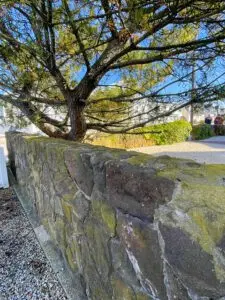
One of the only things that stayed absolutely steady on the back of this turtle was, besides the lighthouse, the stone wall my father had built. I don’t know of other rock walls on the Island – there might be one or two – but my father’s is certainly the only wall I’ve ever seen made of bog iron stones.
My father, Jack Irwin, was from Kansas. He fell in love with Olive, a girl from Northern Ireland. They were smitten. She agreed to move to America as his wife, but it was on two conditions: (1) that she could return to Ireland every summer, and (2) that she could live in a place where every day she could dip her fingers into the same ocean that touched Ireland. So, Long Beach Island it was.
My father found a job as a shop teacher on the mainland, at Southern Regional High School, where he taught for nearly 40 years.
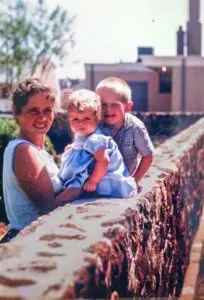
IRISH EYES SMILING: Jack Irwin’s wife, Olive, happily poses with her children, Enid and Kevin, seated on the completed wall in 1963.
Their first house was a rental on Seabreeze Drive in Peahala Park, one of the little Cape Cod houses that dotted the whole Island at the time. Our mother loved the sea but felt lonely and exposed, living in one of these American houses that had no stone wall around it. Ireland is a cozy country, in large part thanks to its countless stone walls that wrap each house and field in a caring embrace. She was lonely on the Island, for lack of a wall.
Our father got permission from the landlord, Bill Gallagher, to build a stone wall around the rental, to comfort his Irish wife. There were no stones on the Island though, and my parents had no money to order them brought from far away. There is hardly even a local stone anywhere in southern New Jersey.
My father found a house that was being torn down in Manahawkin, noticed it had a foundation made of big chunks of bog iron from the Pine Barrens, and made a deal with the owner to buy the stones for $50 if my father dug them out himself. He transported them to the Island by himself, a few at a time, in their light blue VW bug.
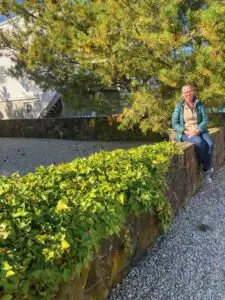
COMING HOME: The author perches on the stone wall, which she visited on Nov. 9, 20 years after last seeing it.
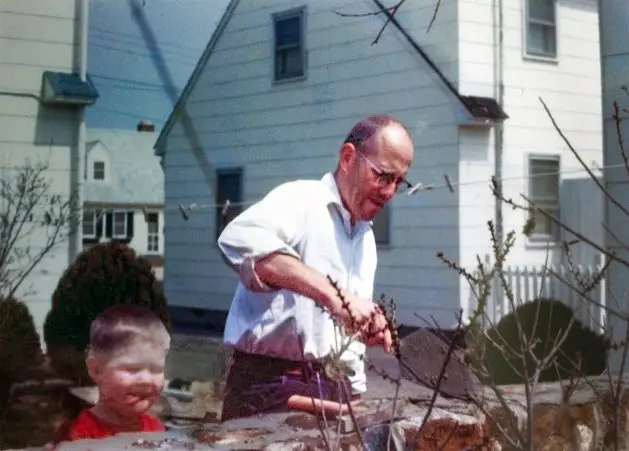
Jack built the wall. He was not a mason, though his father had been. He dug out each stone, brought it to the Island, and jigsaw-puzzled them into a wall, bit by bit, every day after work and on weekends over the space of a year or so.
To this day, the lines of it are perfect. He must have begun it in 1959 and finished it in 1961. It was chest-high and wrapped almost the whole way around the Seabreeze Drive house, encircling my mother, my father and by then two children (my older brother Kevin and me) in its confident arms.
It survived the storm of 1962, a storm where entire houses floated past it down the bay. Even the Cape Cod we once rented is still on the property, only now raised on pilings.
There are old Kodachrome slides, mold-speckled now with age, of Jack spreading mortar with a mason’s trowel, dressed still in his school-teaching clothes. And one of our young mother, in a summer blouse and her hair up in a crown of brown braids, setting us children on the wall as if sidesaddle on a horse.
After a few years, my parents bought a little wooden house on the bay in North Beach, which is where we kids grew up. It did not have a stone wall, though it was surrounded by tall walls of wild bayberry, holly, pine and phragmites, so our mother felt cozy there and our father did not need to build one. Still, they missed their stone wall. Some Sundays in winter when there was no traffic, we would all get into the VW and go on a little pilgrimage to see the wall. My mother would stroke it and pat it like it was a cat, and sigh, and touch my father’s hand.
My parents were of the generation that never said, to my knowledge, “I love you” out loud, but that wall said “I love you” with each stone that was set in place. And it said it for decades after, and still does. If you visit it and are quiet enough, long enough, I think you will hear it.
Enid Irwin Madaras lives in Greencastle, Pa.