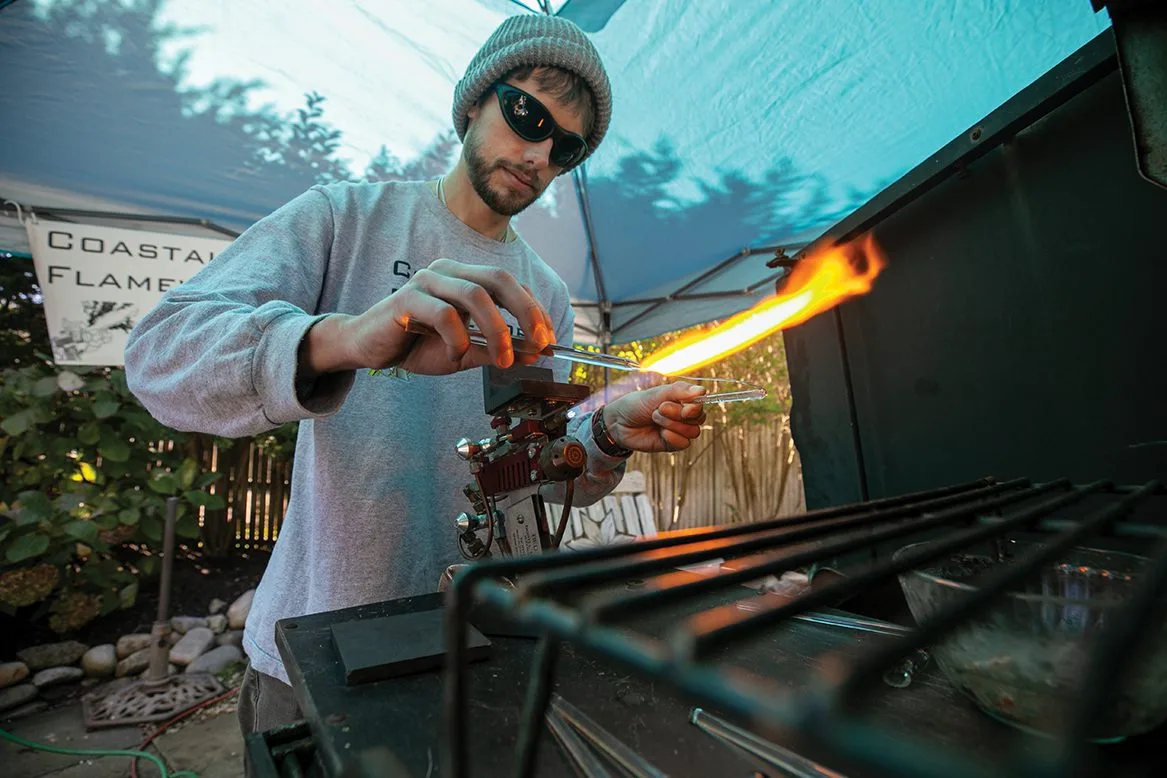
The intricate, sculptural glass art known as flamework or lampwork always captivated Nick Lucia, who creates handcrafted pendants, paperweights and practical pieces as Coastal Flameworks. His creations are sold online and in his mother’s retail boutique, Gifted by the Sea in Brant Beach.
One recent fall day, when the breeze was swirling through his backyard studio, Lucia showed how the walls of his tent setup can be used as a windblock.
Integral to his methodology is his workbench, i.e. an old barbecue grill. His primary materials are borosilicate rods and hot, oxygen-fueled gas flames. In its molten state, the glass is shaped and manipulated using hand tools, heat and gravity. Metallic shimmer and depth can be added by using dichroic glass and a fuming technique.
Borosilicate was Corningware’s original Pyrex material in 1915, Lucia noted, because of its high resistance to thermal shock from rapid temperature change without cracking. (Pyrex shifted to tempered soda-lime glass midcentury.)
The Brant Beach resident volunteers to share his knowledge and progress every Friday and Saturday at WheatonArts in Millville and also works out of Gonzo Glass in Mount Holly. Mostly he makes three-dimensional trinkets, but he can also churn out soft-glass beads on mandrils, which take just a couple minutes each.
Before he learned the skills he has today, Lucia had met makers of sculptural glass art at festivals and was smitten with the mystery of how it came to be.
“I was always blown away,” he said. “Never had any idea how it was made.”
One artist at Camp Coldbrook Music and Art Festival in Massachusetts especially impressed him. “I saw him making eyeball pendants,” Lucia said.
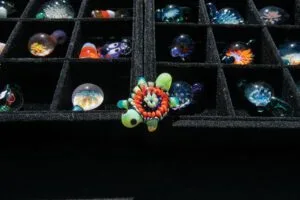
An ‘implosion’ technique gives a turtle shell some pizzazz.
His journey took him to California, where he had group lessons at a flameworking studio. When he moved back to New Jersey, he enrolled in a glass program at Salem Community College, at which point he bought his torch and other tools.
Since starting Coastal Flameworks about three years ago, his experience has grown and his practice has become more refined. While he still doesn’t identify as an artist in the traditional sense, he knows he prefers the bespoke or “fine craft” approach over a uniformity-oriented production setting.
“I realized recently that I guess I like creating things,” he said. The creative urge has manifested throughout his life in the forms of doodling and designing, guitar and songwriting.
The example he demonstrated was a turtle. Lucia warmed up some scrap glass and attached a punty (or pontil) to the workpiece with a hot seal.
“I make sure it’s as even as possible, rotating and slightly pulling it till it’s completely firm,” he explained. “I want it to be as centered as possible, because if it’s not centered, the whole thing is going to come out wonky.”
Over the roar of the torch, he narrated. He starts a gather at the tip of the rod where a sphere will take shape – “I’m basically making a marble, using heat and gravity to pull the glass down” – and keeps the flame directly under the spot where the gather forms.
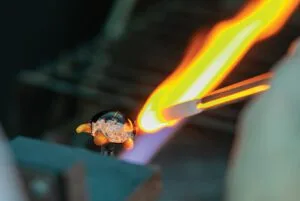
The flame is applied to the spot being manipulated.
He then showed the “implosion” technique, placing a pattern of dots on the surface of the turtle’s shell, taking care to avoid “skuzz” or tiny impurities/bubbles getting trapped in the glass. Using heat and gravity once again, he coaxes the dots to meet at one center point and start going upward.
Asked if the process is therapeutic, he replied, “Big time.”
“When I’m in the zone and I like what I’m making,” he said, “I’m not thinking about anything else in the world.”
Another layer of color is added by sticking to the surface some frit, or fine chopped-up glass – for the task at hand it was double-amber purple and experimental green #5. Using black as a background makes the color stand out, he noted.
The turtle’s head and four limbs are added next and, finally, eyes to bring the little guy to life.
A crucial part of the process is annealing the glass, or heating slowly and with control to relieve internal stresses and avoid spontaneous cracking or shattering. The kiln formula calls for a 30-minute “soak” at 1,050 degrees, he said.
The holidays are on their way. Visit @coastal.flameworks on Instagram and eBay to browse and shop.