About 20 years ago, Matthew Litt was having trouble getting into the Christmas spirit. He was a new lawyer in New York City, and it seemed as if he didn’t have time to look at anything other than his job.
“I felt like I wanted to grab a little bit of Christmas spirit because I felt like it was getting away from me,” he told an audience at the LBI branch of the Ocean County Library on Saturday, Nov. 14. “The only spare time I had was on the subway to and from work. So I thought, ‘What can I read on the subway to help me get into the Christmas spirit?’”
Litt got on the fledgling internet and found a bunch of newspapers from 1945. He started printing out copies of stories from December 1945 and reading them on the subway.
“The stories I was reading were incredible; I couldn’t believe what I was seeing – some of the most beautiful expressions of patriotism and just human conduct that I’d ever seen.”
He put his reading project down on Dec. 26, but on Thanksgiving of the next year he was finding more newspapers and doing the same thing. Two or three Christmases passed and he ran out of newspapers, so Litt started going to speak with people who either remembered Christmas of 1945 or remembered stories that their parents had told them.
“Those stories, again, were just incredible. I had no intention of writing a book, but I felt at that point the stories were too good to live and die with me. I needed to put them down on paper. … I went into this after reading the newspapers with a hypothesis – that idea was that Christmas 1945 was the crescendo of American spirit. Right? VE Day happens in May of 1945, America’s happy about that. … A few months go by and now we have VJ Day, and again, America’s thrilled. … A few more months go by and now it’s Christmas 1945, so I’m looking at it like it’s been a seven-, eight-month celebration where everyone loved their neighbor and loved their country.
“And when I spoke with people that were there, they set me straight. It wasn’t a crescendo, it wasn’t a grand finale, it was more like a curtain call. Because what happened was that almost immediately after VJ Day, after four years of being completely selfless, Americans needed to think about themselves; and their families; and where they were going to work all of a sudden; and where they were going to live. And all of these issues that had been put on the shelf. So, that disappointed me at first. And then I thought about it, and it made me fall in love with this project all over again.”
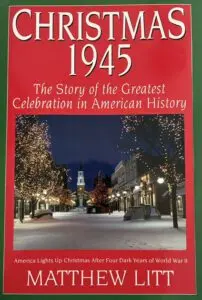
So he indeed did find a publisher and wrote that book, Christmas 1945: The Story of the Greatest Celebration in American History, America Lights Up Christmas After Four Dark Years of World War II.
The book was published in 2010 and sold well. Litt was invited to speak at venues such as the Truman Presidential Library in Independence, Mo.; the Franklin Roosevelt Presidential Library at Hyde Park, N.Y.; and the Battleship New Jersey in Camden. He ended up writing an article about Christmas 1945 for Time Magazine, and appeared on numerous TV and radio programs, discussing his book.
Wait a minute. That book came out 16 years ago; why is Litt still talking about it?
Well, Sherry Brady, a co-chair of the program committee of the Friends of the Island Library, invited him to speak. She happens to be Litt’s mother-in-law. (He joked before his presentation that he was more nervous speaking before her than in all his previous lectures.) She figured her son-in-law could provide an interesting and thought-provoking program as Holiday Season 2026 was kicking off.
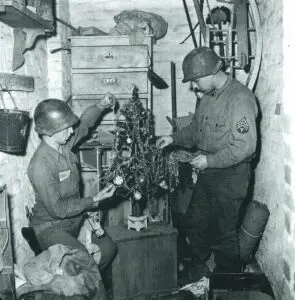
In 1944, soldiers of the 84th Infantry Division decorate a tree in Germany.
Brady was correct. This holiday season many Americans are finding it difficult to fill their gas tanks and refrigerators, but during WWII, folks faced much bigger worries such as would their loved ones return alive from Europe and the Pacific. Litt, though, showed how resilient Americans were and how they celebrated when the long war was finally over.
Litt’s 40-minute speech was crammed with historical tidbits. For example, British Prime Minister Winston Churchill had sneaked into the U.S. to confer with President Roosevelt after the Japanese had bombed Pearl Harbor and the U.S. had entered the war.
Litt didn’t mention one historical fact. The United States had declared war on Japan on Dec. 8, 1941, the day after the Pearl Harbor attack. However, it didn’t declare war on Germany at that time. Adolph Hitler and Benito Mussolini made the mistake of declaring war on the U.S. on Dec. 11, and Congress immediately returned the favor. Thus the discussions between Churchill and Roosevelt.
Litt, however, did bring up a fact of which most Americans likely aren’t aware: Churchill joined Roosevelt in the annual Christmas Eve lighting of the national tree ceremony. Churchill spoke to the country via radio: Let the children have their night of fun and laughter, let the gifts of Father Christmas delight their thoughts; let us share to the full in their unstinted pleasure before we turn again to the stern tasks in the year that lies before us. But now, by our sacrifice and daring, these same children shall not be robbed of their inheritance or denied the right to live in a free and decent world. And so, in God’s mercy, a Happy Christmas to you all.
It’s funny, isn’t it, that the British say Happy Christmas instead of Merry Christmas. But it would be the last national Christmas tree lighting in the U.S. until 1945. In fact, although Roosevelt made many speeches in the next few years, updating Americans on how the war was going on, he would barely mention Christmas.
Litt went on to explain how the Christmas holiday struggled to survive during the years of WWII. The war situation became more grim each year, with millions of American men and women (thanks to the WACS, the Women’s Army Corps) serving overseas, with casualties mounting, with rationing of things such as gasoline and tires making holiday visits with distant families almost impossible while the rationing of food severely reduced the size of holiday dinners.
Yet, Litt had found many newspaper articles and printed letters that were poignant. Some revived Americans’ spirits; others were downright tearjerkers.
War Bonds as Presents
He sprinkled articles and letters from his book into his lecture. When the U.S. was first involved in the war, people and the government were training for the dark tasks ahead and building confidence and a spirit of teamwork. Here’s an advertisement that appeared in newspapers across the country in 1942, ascribed to Santa himself:
We’re partners this year, Johnny Jones, You and I and Uncle Sam. Other Christmases maybe you didn’t think so much about Uncle Sam … but this Christmas is different.
We want you to have just as much fun as ever, Uncle Sam and I. We want you to hang up your stocking on the same mantelpiece and go tip-toe down the stairs at the first streak of dawn to open your presents, just like always. We want to be sure you’ll have a Christmas next year, too, and the next and the next year, too, until you have children of your very own to hang up their stockings, too.
That’s why you’re getting a War Bond or Stamps this Christmas, Johnny, instead of some of the toys and things you wrote down in your letter to me. I figured you’d rather have them than that electric train, when you stopped to think about it.
You see, Johnny, your War Stamps make you a soldier, too, just like you’d be if you were big enough to shoot a gun or fly a plane or drive a real tank. They mean you hold a stake in America. They mean some day you can tell your children just like this: ‘Yes Sir! There’ll always be a Santa Claus.’
The audience laughed when Johnny was told he’d be getting a War Bond for a gift. As Litt said, there was still a bit of whimsy in 1942. Not so in 1943, when the losses were starting to mount up and sure to get greater. Litt had uncovered a letter from a WAC captain to her parents in Chicago:
This is war – and War is Hell. It’s Christmas Eve – and instead of being at home with you, amidst gaiety and happy clamor, I’m in the bleak waiting room of the railroad station in Maxton (England), waiting to put a coffin on the train. A nice young flyer was killed last night when his glider plummeted to the ground. He was to have been married tonight.
Litt included several other readings in his lecture, too many to fully document here. However, one simply begs to be recorded, a lighthearted poem written by an Army attorney in Manila, where he was working on a Japanese war crimes trial after the war had ended, to his wife and three-year-old daughter back in the States. The tone of the times was remarkably different from the years before.
‘Twas the night before Christmas and all through the yard,
Not a creature was stirring, not even a guard
Our socks were stuffed in our shoes to save space,
And alas – in our tent there was no fireplace.
My friends in their shorts and me in my shoes,
Had just settled down for a tropical snooze.
When out in the area there arose such a clatter,
That I sprang from my cot to see what was the matter.
I became so entangled in my mosquito net,
That if no one had helped I would be there yet.
And then very cautiously I pulled back the flaps,
Expecting to see a battalion of Japs.
But to my amusement I saw there instead,
The famous St. Nicholas in his suit of bright red.
He sat in his sled which was pulled by six jeeps,
As they bounced around gaily in short little leaps.
Then they came to a halt and away Santa went,
And then he was beside me right there in my tent.
In the interest of shortness, we’ll jump ahead to when Santa started handing out his gifts:
Then he reached in his bag without hesitation,
And gave to my tent mate a pack of K ration.
He dug in again and came up with some Spam,
C ration cookies and Bully Beef Ham.
He followed this quickly with dehydrated potatoes,
And then he reached for a can of tomatoes.
He then remarked there was work he must do,
So he raised a plump finger and away he flew.
Litt’s presentation was, at times, simply jaw dropping, at other times humorous. And here’s some good news – you can buy his book by Googling “Christmas 1945 author of book.” A hard copy signed edition will cost only $24.95. Stay away from Amazon, which has only two copies left in stock and is charging $82.31.
Here’s some better news – the christmas1945.org site offers discounts for purchases of more books in case you would like to send some out as gifts. For example, you could buy five for $92.50 instead of $124.75.