Hollywood and a plethora of apocalyptic short independent films on YouTube have increased my nervousness over asteroids striking the ocean and generating Himalayan-grade mountains of water, moving shoreward at hundreds of miles per hour – while I’m down in Holgate, clueless. Then, only last week, I found science-based solace after reading multi-agency reports assuring that even a large asteroid striking the ocean would not be the tsunami threat long been bandied about.
The chance of any tsunami hitting LBI full force is even less so. More on that below.
Ocean-impacting asteroids, even those of a fairly common once-in-a-millennium size, simply aren’t the generators of massive waves once envisioned.
Of course, there’s no frivolously dismissing once-in-eons catastrophic asteroids, dubbed “planetary extinction events,” like the 3-mile-wide space rock that slammed down just to our south, a mere 35 million years ago. It struck the sea at 40,000 mph, creating the later-named Chesapeake Bay Impact Crater, some 53 miles wide.
That event was a “wet-target” oceanic hit, the impact zone being a shallow sea with soft, water-saturated sediment on the bottom. It triggered a massive mega-tsunami that overwashed most of northeastern North Carolina.
And who can forget, academically speaking, the granddaddy of extinction asteroids that left the Gulf of Mexico and/or America in its wake?
But this segment is about the latest NASA announcement asserting/assuring, “The asteroid impact tsunami threat is not as great as previously thought.”
This was quietly evidenced by a “larger than average” asteroid that slammed into the southern Atlantic Ocean on Feb. 6, 2016. It was about 23 feet across, having the power of 13,000 tons of TNT.
The space-rock oceanic crash-landing was fully fanfare-less, despite the long-held belief that such a sizable hit would be a sure tsunami-sender. It wasn’t, not that anyone would have been prepared.
The splashdown came as an after-the-fact shock to skywatchers. It went fully unobserved prior to hitting the sea surface, eventually detected by NASA’s Center for Near Earth Object Studies.
NASA later surmised that it surely made quite a showy splash, instantly issuing shock waves and asteroid winds, enough to spook marine and avian life in the immediate vicinity.
Most significantly, there were no related tsunamis of any size appearing along the closest coastlines.
It is believed much of the asteroid’s impact energy was instantly dispelled through a water column and vapor launched over 1,000 feet into the air.
The takeaway was even relatively large asteroids hitting the sea surface aren’t likely to have any impacts on distant shores.
Relatedly, Galen Gisler from the Los Alamos National Laboratory created detailed computer simulations to graphically show how open-ocean asteroid strikes might play out on nearby land masses.
“Fortunately for anyone living near a beach, it doesn’t look like a marine-landing would be all that bad, as long as it’s not too close to the beach,” offered Gisler.
As to asteroids hitting “too close” to the beach, scientists are rapidly reworking possible shoreline impacts, based on the downgrading of tsunami-generating potential of splashdowns.
Should a close-in strike issue tsunamis toward us, LBI seemingly has a leg up on other areas along the coastline. Harvard University computer modeling shows the prominently wide, gently sloping underwater contours off our beaches would act as “a natural tsunami buffer, reflecting much of a deep-sea wave’s energy back into the open ocean.”
Those underwater geological influencers, like offshore canyons would “redirect the wave energy,” deflecting it, mainly southward.
According to Harvard University’s projections, that’s good news for us and bad news for the deflected-upon Atlantic City area.
MANN OVERBOARD: Despite my constant urgings, the Island does not have a tsunami early-warning siren system.
Sirens in limbo, it might be time for a multi-mile loudspeaker array, like those used to talk the public through “harbor waves” in Japan.
In proposing this warning system, I had to suggest applicable warning vernacular.
The arriving announcement would be heralded by an overwhelming sound to get everyone’s attention. I think a few guitar notes from a raucous Metallica rift would suffice.
After attention is gotten, a calmly spoken message should go something like “This is a public service announcement. There are currently 75-foot tsunamis heading our way at great speed. Do not panic unless absolutely necessary.
“For those residing near the Causeway, an evacuation is in order, keeping in mind the ‘first come, first serve’ rule.
“Should you become stuck in traffic within walking distance of the Big Bridge, calmly but hurriedly walk to its peak, which is 100 feet high, which makes good tsunami sense.
“Once atop the bridge, a few extra feet of escape altitude can be gained by standing atop stuck vehicles. Please do not fight over roof space.
“For others on the Island, it is suggested that scaling nearby water towers on those tiny ladders could work. Remember that women, children and public service announcers take priority.
“If water towers get overcrowded, simply shimmy up the tallest utility poles. No quarreling over poles. There are plenty to go around.
“If thoroughly stuck on the ground, turn to surfboards, paddleboards and kayaks. Simply place on the dry ground, facing away from the arriving waves. When waves are imminent, mount the IEDs (improvised escape devices) and begin a frantic paddling motion, being in full paddle form as the waves hit.”
As a final impetus, the announcement ends with an encouraging “Otherwise, have a nice day.”
CORMORANTS UNDER ATTACK: When it comes to migratory shorebirds, nothing stands out in fall skies like southbound double-crested cormorants, with many formations hosting 75 or more of the large, black diving birds.
With many coastal diving birds struggling to keep their heads above water, numbers-wise, cormorants are bucking the trend, doing remarkably well – apparently a little too well, according to scientists, anglers, fish hatcheries and even some bird enthusiasts.
Concerns have been focused on the hefty population of this ravenous species, each bird routinely downing a pound of fish and crustaceans per day.
Multiplying that intake by a million or more cormorants in North America, the total take of marine life is huge.
New Jersey alone has tallied 250,000 cormorants during bird counts.
It is feared the species is single-wingedly unbalancing the ecology it thrives within. The federal government agrees.
This month, the U.S. House of Representatives unanimously passed HR-8195, the Responsible Cormorant Management and Control Act of 2026. The Senate is considering the companion bill S- 5514.
As the legislative label suggests, this is not overly good news for the cormorants, considering the act’s intent is to “significantly reduce” their numbers.
It would be a trying task.
Legally, the species is protected under the federal Migratory Bird Treaty Act. This means cormorants won’t be easy to safely and singularly target without rustling the feathers of those who fear the action might inadvertently threaten protected species in a collateral-damage manner.
In N.J., cormorants are not listed as a migratory game bird. This prevents them from being hunted.
Any cormorant kill-offs (my term) bring up the distasteful matter of wanton waste.
The birds do not present as decent table fare, offering minimal meat with a flavor commonly tagged as “muddy,” though Native Americans feasted upon them and, more so, their eggs.
In first presenting the cormorant-control legitimization, sponsor Rep. Tim Walberg (R-Mich.) said the species has been linked to declining fish numbers, while also complicating fishery restoration efforts and hurting recreational angling.
“In the Great Lakes, cormorant populations have wreaked havoc on fish stocks, inflicting millions of dollars in damage to the Great Lakes fisheries and threatening $5.1 billion in economic impact for recreational fishing,” said Walberg.
Taylor Schmitz, senior vice president and chief operating officer of the Congressional Sportsmen’s Foundation, commented, “By directing the U.S. Fish and Wildlife Service to work with the Regional Flyway Councils on regional management frameworks, this bill offers a practical, science-based path to better support states and the communities that depend on healthy fisheries.”
N.J.’s Pequest Trout Hatchery in Warren County would likely benefit from a cormorant reduction. The hatchery’s annual statewide trout stocking work has long been tormented by opportunistic cormorants snagging the trout before anglers can get at them.
Locally, trout pilfering by cormorants occurs at Pohatcong Lake in Tuckerton.
To counteract the avian intrusion, New Jersey Fish and Wildlife has improved the anglers’ chances. Last spring, the division eliminated the traditional three-week spring “preseason closure,” giving anglers an extra 19 days to get at the trout.
The effort seemingly rolled off the backs of the birds. Being the better of the two trout seekers, cormorants still easily managed to get their fills, sometimes performing uncustomary night plunges, assisted by the artificial light from nearby buildings and streetlamps.
As to how the upcoming culling could be done, that would be worked out in the final legislation, though culling must be done under “controlled circumstance,” per the U.S. Fish and Wildlife Service.
“Lethal take is strictly limited to authorized entities – such as state/federal wildlife agencies or aquaculture operators – holding special USFWS depredation permits to address severe fishery, property, or safety conflicts, and nonlethal methods generally must be tried first.”
Ultimately, shooting is the surest removal method. Per Wiki, “The most common lethal method, performed by wildlife agency sharpshooters, aquaculture operators under depredation orders, or permitted hunters. Birds may be targeted on the water, in flight, at roost sites, or at breeding colonies.”
Pequest could go the sharpshooter route if noise deterrents, like “bird bangers” (propane cannons), don’t get the job done to Control Act specifications.
A more-insidious reduction method is the oiling of nested cormorant eggs, a process uncoyly called “smothering.”
Smothering is done by applying corn oil or mineral oil onto unhatched eggs. The oil clogs the porous shell, slowly depriving the embryos of oxygen. The embryos suffocate, though the parents continue incubating. Any effects on the population take a few years to appear.
There is no scheduled public comment period on the Senate phase of legislation; however, individual senators can be contacted.
INSUFFERABLE THIEVERY: A deplorable offence befell a public service effort at the Barnegat Lighthouse State Park.
With so many visitors and fishermen lining the bulkhead just west of Andy’s at the Light, fears arose that this folk or that might fall into the drink. In a pro-active move by the park, two classy life ring units, replete with ropes and enclosure cabinet, were purchased and installed within easy reach of the public, most notably the angling public.
The throwable personal flotation devices cost $400 apiece.
You might guess where this is going.
Sure enough, some numbnuts stole one of the throw rings and accoutrements, leaving only the bolted-in cabinet.
That’s mean. “Screw everybody. This will look cool in my Maritime Room.”
The park service sent a police officer to investigate, though it’s unlikely anything further can be done – unless you just happen to know something (?).
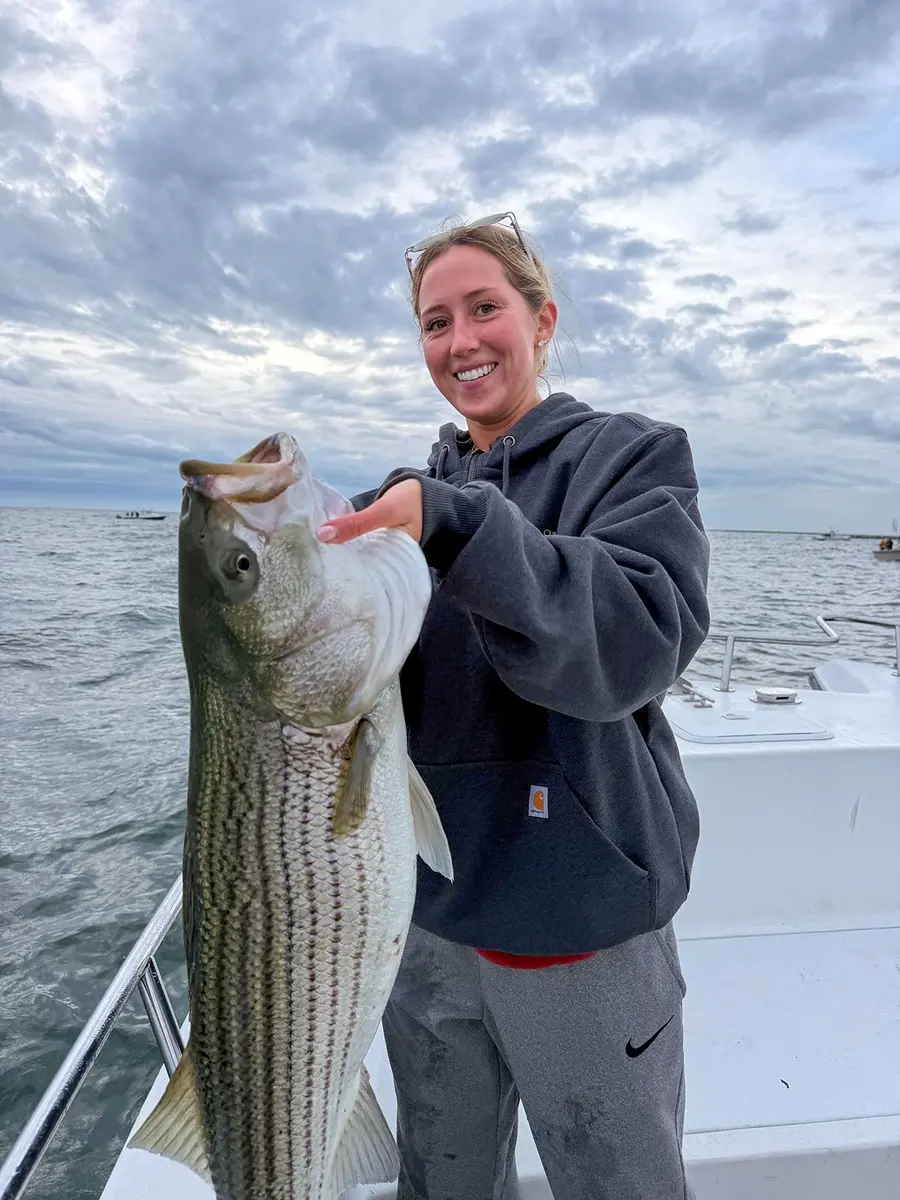
RUNDOWN: It’s getting late, but not too late. Our main bass biomass is being coaxed into staying nearshore by the lack of any significant coldness. In fact, the skies are aligned to have the schoolies hanging around well into December. Take advantage.
Expectedly, striped bass are making a nice late push in the final days of the 2026 LBI Surf Fishing Classic. Those numbers would surely shine a lot brighter if only more anglers had joined. I’ll wax poetic on the matter in the next column.
Togging still takes the surfcasting cake when it comes to land-based anglers, mainly in the Barnegat Inlet area.
For reef and wreck fishermen, the five-fish tog bag is worth the fuel costs.
That nearshore boat action is banging black seabass and porgies in huge legal numbers.
Check headboat ads for late-fall fishing trips.
For surfline and even bay fun, there seems to be a showing of formerly very common cod-like hake and/or ling. I’m in. Think lighter bottom tackle and shrimp baits, even chunks of edible store-bought shrimp.