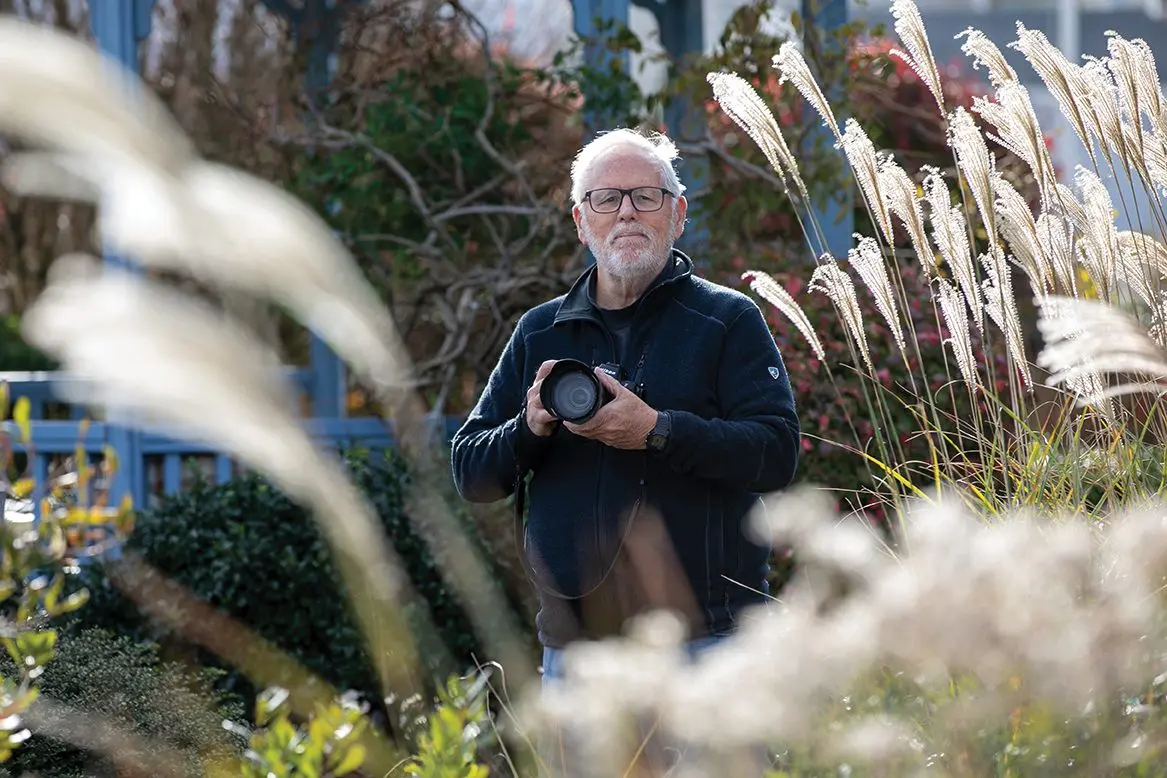
Photography has taken Brian Horton everywhere, from the Winter Olympics in Lillehammer, Norway, to Dhahran, Saudi Arabia during the first Gulf War. After 38 years traveling the country and world as a photojournalist for the Associated Press, his passion has now led him into his own backyard of Long Beach Island, capturing the simple beauty of home.
“I shoot by a magnitude of a hundred times more now than I ever did as a photographer,” he said.
Originally from Richmond, Ind., Horton found a love for the Island after renting a home on 86th Street in Long Beach Township with his wife and friends in the early ’90s. Eventually, he and his wife purchased a home in Long Beach Township in 1999.
For decades, Horton’s subjects were athletes; as the AP’s sports editor, he oversaw coverage of Super Bowls, World Series, Olympics and more. In his retirement, he’s taken on a more local angle, shooting the most unpredictable subjects of all.
“I have really gotten into birds. All my friends make fun of me, all my former AP colleagues. I said, ‘You’ve got to try it. It’s a lot harder than you think.’ When you’re covering a football game, you know pretty much what direction you’re going and you know the definition of the stakes. You know when it’s going to start, when it’s going to end, and with birds, you don’t know any of that. You could be the most knowledgeable, and you don’t know when that bird’s going to leave that branch,” Horton said.
The time, effort and patience it takes to perfectly capture a bird is a different kind of challenge than he has experienced over his career. But the change of pace and freedom have allowed Horton to reconnect with the art of actually taking a photo.
“So much of your time, when you’re working as a photojournalist, is not actually spent making pictures; it’s getting an assignment set up,” he said. Between planning, assigning, scheduling and commuting, “None of that actually produces a picture.”
“Now I go out three or four times a week, and sometimes I’ll go out for three or four hours. And there’s no one to say, ‘Don’t do that,’ or ‘I need you to go here,’” he said.
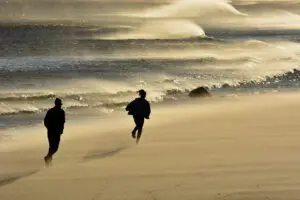
BLOWN AWAY: Horton captures Island life through the seasons, such as in this January 2020 photo of a windswept couple running on a Holgate beach. (Photo by Brian Horton)
Horton spends time photographing wildlife and natural landscapes on the beach and at places such as the Edwin B. Forsythe National Wildlife Refuge. Beyond nature, he still likes to tell a story: “The journalist in me, I can’t let that go,” so he searches for “picture situations” that allow for an insightful caption or have a more meaningful message.
A Life in Photos
Horton’s passion for photography has been a lifelong pursuit. His first introduction to the field was through his father, who worked for The Indianapolis Star. He was hired as a copyboy at the Star his senior year of high school, and was happy to find that “if you came up with an idea, they would never say no.”
Horton started taking his own photos at around 16 years old. Initially interested in writing, he was partially drawn to it by the welcoming photographers he met. They were often happy to have someone accompany them on assignments, as it’s a “lonely pursuit,” Horton said. Their encouragement was a reason to stick with it.
“I like to tell stories and I like to take part in things and it just seemed like the entree,” he said.
When a gas main explosion caused major damage in his hometown, Horton made sure he was there to capture it.
“My dad said, ‘You should go over there because no one’s going to know the town as well as you do.’ So I went over there, and it happened to coincide with spring break at my high school, and I spent the whole week there. I had a picture on the front page the next morning,” Horton said.
And so began a career of chasing stories and shots all over the world. But his career wasn’t limited to just taking photos and leading coverage; he also played a part in introducing groundbreaking technology and major shifts in photojournalism. Horton was involved in the implementation of and transition to digital cameras.
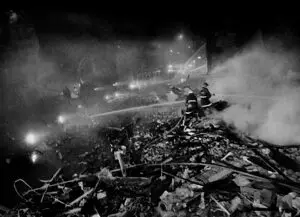
THE BEGINNING: Horton’s first front-page photo in the Indianapolis Star, where he was a copyboy, showed firemen pouring water on the remains of a collapsed building after a natural gas explosion in Richmond, Ind., on Saturday, April 6, 1968. The early-afternoon explosion in the crowded downtown area killed 41 people and injured more than 150. (Photo by Brian Horton)
“The camera in your phone is the great-grandchild of that,” he said.
Horton’s colleague at the AP came up with the idea of an electronic darkroom, “before they had electronic pictures,” he said. The AP then worked with people at Eastman Kodak to build a camera, which ultimately was rejected by the higher-ups at the company, who said, “‘When you think Kodak, you think film. We don’t think this digital stuff is going anywhere,’ and they bailed out,” Horton said. They were, of course, proven wrong, and Horton was instrumental in integrating the new technology.
“So I didn’t build the cameras, but I was told, ‘OK, we’ve got to work this. We’ve got to get this into our workflow.’ So I had to think, ‘OK, how do you do that?’”
Some of his fondest memories as a photojournalist come from his time covering sports, and the dozen Olympic games he covered are among the most memorable assignments over the years. His favorite experiences were in Lillehammer and in Sydney, Australia.
“When you’re doing the Olympics, the games themselves are the easiest part of it. We’d spend two or three years doing trips to wherever it was going to be. We’d start out looking at blueprints and diagrams of the stadium and camera positions and stuff like that before they even dug a hole in the ground. So you saw it grow up,” Horton said.
Earlier on in his career, he found a love for Major League Baseball. At one point, he covered about 30 to 40 games a year when he was located in Philadelphia, then about 80 games when he was in Cincinnati.
“I liked baseball because the people were so interesting. Baseball is a lifetime thing – the coaches all played, and everyone started out at 5 years old. The storytelling was amazing,” Horton said.
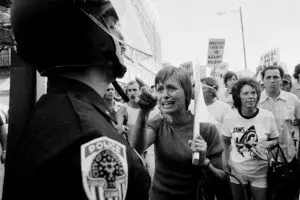
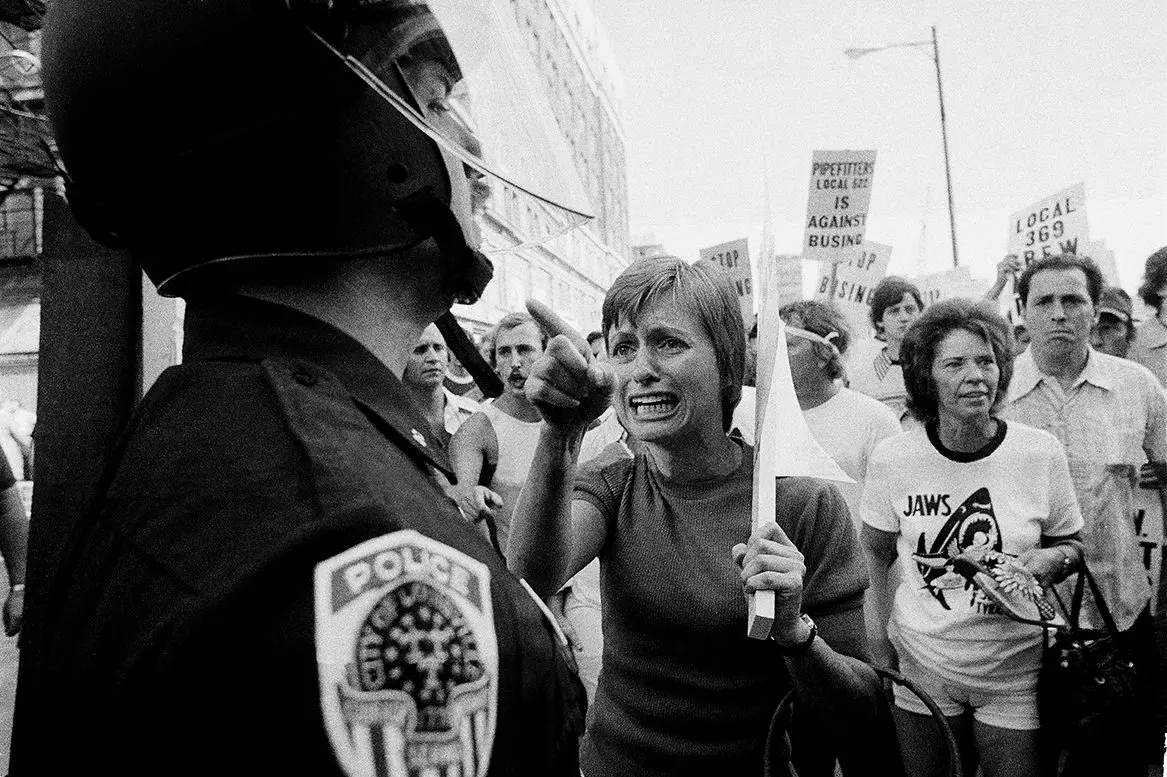
MAJOR IMPACT: Horton’s photo of an anti-busing demonstrator during a period of unrest in Louisville, Kentucky, taken on Sept. 5, 1975, was nominated for the Pulitzer Prize. (AP Photo/Brian Horton)
Times have since changed, but Horton loved being in the world of baseball for the close relationships he was able to form with players, from giving them rides home after a game to taking photos of anticipated Most Valuable Players in their homes, while kids played in the living room. Now, it seems to be “more of a business” all around, but Horton treasures the experiences he had getting to really know people.
“When Pete Rose signed with the Phillies for a million dollars – he was the first non-pitcher to be paid a million dollars – I spent that morning with his wife at Kmart, because she went to get their son new tube socks, because they were on sale. But we rode to the Kmart in a Rolls Royce,” Horton said.
New Perspectives
Horton also covered dozens of Super Bowls over the years, but one in particular is most memorable: Super Bowl XXV, hosted in Tampa during the Gulf War, where the United States Central Command was located. Horton was in the midst of post-Super Bowl excitement when he soon received a life-changing phone call.
“At that point, I didn’t know I was going. So you’re caught up in all that, and then I get a call saying, ‘Hey, what do you got going on next week? Is your passport up to date?’ I went into the office; nobody said anything. Friday they called me at home and said, ‘Could you leave Monday for Saudi Arabia?’” Horton said.
His history of managing groups of people gave him a sense of readiness as he took the task on.
“I always thought the best thing a boss can do is give his crew all the tools they need and then get out of the way. So I think that’s why I felt that way – because I’m used to going in and kind of quickly putting something in order,” Horton said.
His experiences in Saudi Arabia were unlike anything he’d covered before. Every time there was a Scud missile alert, CNN (which was based just down the hall from Horton in his hotel) would go live, and Horton would routinely call his wife to let her know he was OK when that happened.
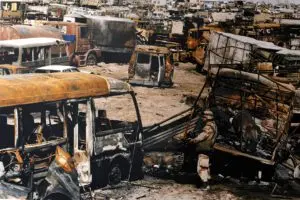
SOMBER SCENE: Horton covered the First Gulf War. He captures destruction on a highway outside Kuwait City in March 1991. (Photo by Brian Horton)
“Well, one night I was talking to her, and it hit the other end of the block. When it went off, all the windows shook and the tiles fell out of the ceiling and stuff like that, right in the middle of telling her ‘It’s no big deal, it’s another false alarm.’ I just said, ‘Gotta go!’” Horton said.
In those situations, he was at first relieved for his safety and the safety of those in the building, and then shifted into reporting mode, directing photographers to get out there and document the moment.
Looking back, Horton feels the war was probably his “most consequential” assignment, he said.
“You’re sending people out on assignments and into situations that you have no control over. If you send somebody to cover archery at the Olympics, the chances of them getting hurt are pretty low,” he said.
Horton also drove the shift to multimedia storytelling, as the AP pushed to utilize digital news. He’d made the transition from photos to digital multimedia just months before 9/11, when online information was still limited, and the AP’s coverage was a vital source.
The organization’s early innovation when it was most needed was a constant throughout his career, Horton said.
“That was one thing about working at AP my whole career. We weren’t political one way or another; we were down the middle and we had people everywhere in the world, so there wasn’t much that could happen that we couldn’t stick our fingers into,” he said.
A Future for Photographers
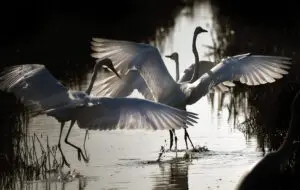
RUFFLED FEATHERS: More recently, Horton takes to photographing birds and wildlife around the LBI region, such as this quartet of Great Egrets flitting around in the water near Tuckerton in 2021. (Photo by Brian Horton)
Horton has experienced a multitude of changes in both photographic technology and the media industry. One of the biggest developments today is the rise of artificial intelligence, and its potential impact on photographers.
“What concerns me is that if a picture is especially well done in reality, the immediate assumption is that it was AI – that nothing could be that sharp, or the colors couldn’t be that vivid. Because all of a sudden, everybody’s an expert of photography because they have a phone in their pocket,” he said.
His advice for photographers in today’s landscape is to “rise above the noise.”
“They have to hold themselves to higher standards. All people need is one slip; they don’t remember the hundred you did right, it’ll be the 101st one. It could be as simple as darkening an area or cleaning it up. I try to think: If I couldn’t do it in a wet darkroom, I’m not going to do it,” Horton said.
After capturing and being part of so many incredible and impactful moments all around the world, the significance of home feels poignant to Horton There are important things happening everywhere, and wherever you are right now is no exception, he said.
“I would also hope that people realize there are a lot of important pictures to be made at home. When I was growing up, I thought you had to go cover the famine in India or you had to spend six months in a pueblo in Colorado to tell a good story.
“There are a lot of good stories. You shouldn’t overlook where you live,” Horton said.